October 2026
Data Sovereignty in the Age of AI
- Context
- New York University · Comparative Political Economy · October 2026
- Team
- Victor A. Kiani (author) · Jasmine Pacheco & Reya Sureshkumar (research)
- Work
- 23-page reading deck comparing the EU, U.S. & China
- Focus
- AI procurement, data rights & supplier lock-in
Businesses buying AI are often sold sovereignty as a label: a domestic supplier, or data stored at home. In a group research report, Victor Kiani tested those labels against the rules of the European Union, the United States, and China, and argued that control only counts when a business or a person can actually exercise it.
Group research report completed in October 2026 for an NYU course in Comparative Political Economy. Page through the full reading deck below, or download it as a PDF.



Three labels that settle less than they promise
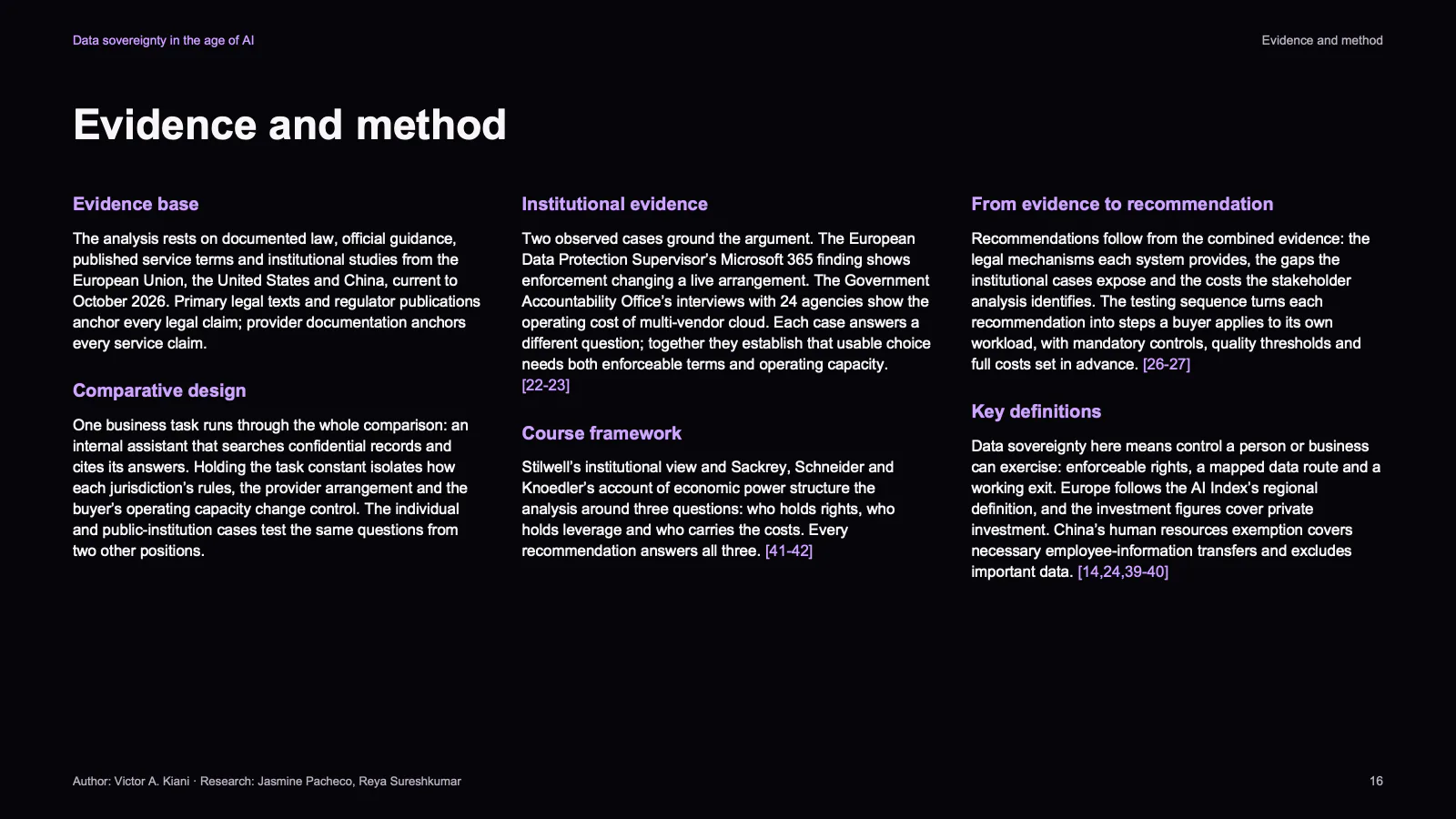
The report followed one realistic purchase through the whole comparison: a company that wants an internal AI assistant to search confidential records and cite its answers, where some of those records hold customer or employee information. Holding that task constant showed how each jurisdiction's rules, the provider arrangement, and the buyer's own operating capacity change who is actually in control.
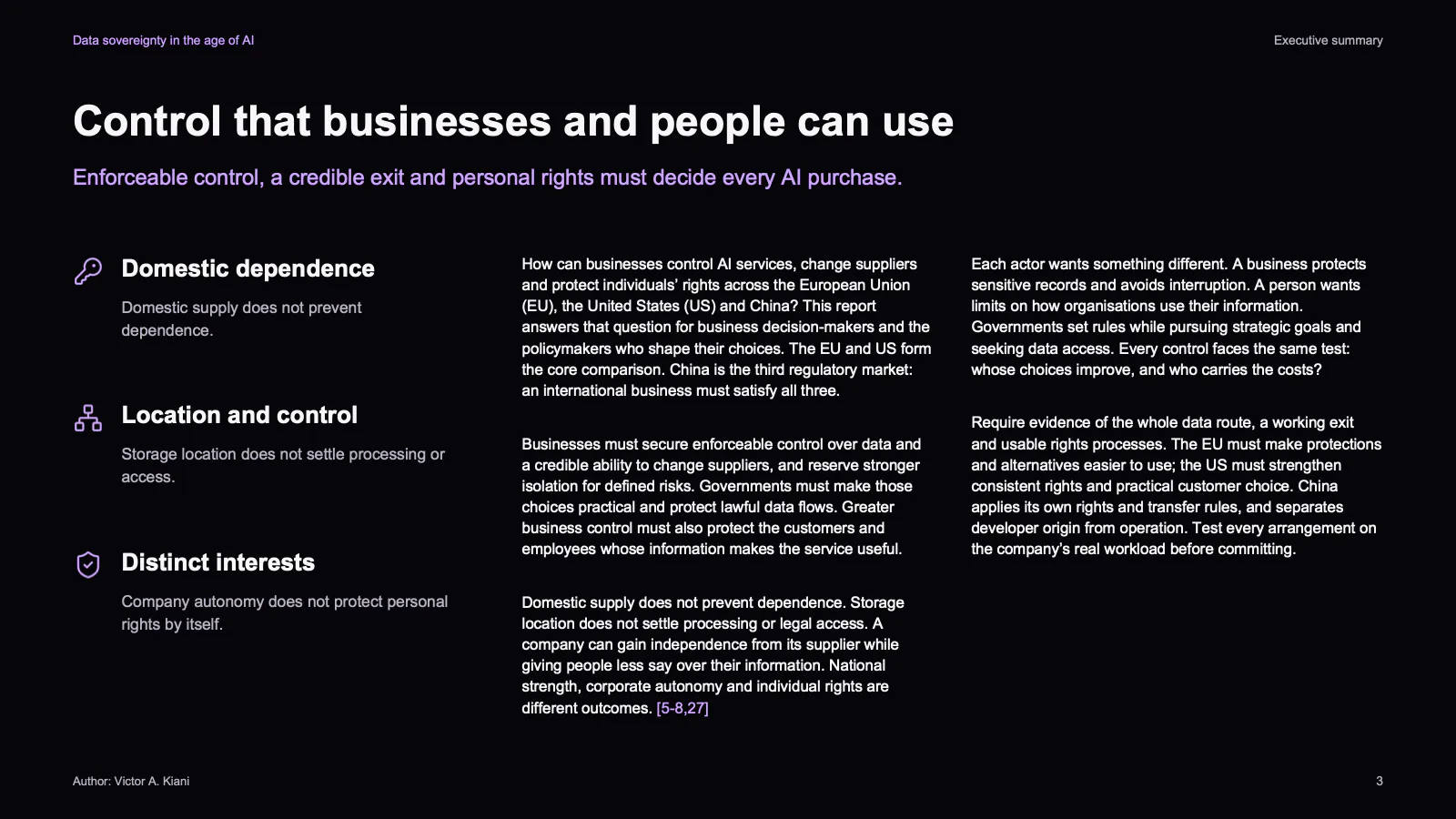
- A domestic supplier can still create dependence. An American business buying American AI can face the same switching problem as a European buyer. Supplier nationality does not stand in for bargaining power.
- Storage location does not settle processing or access. Storage, model processing, logs, and support access can follow different routes, and 18 U.S.C. § 2713 reaches records in a provider's possession, custody, or control regardless of where they are stored.
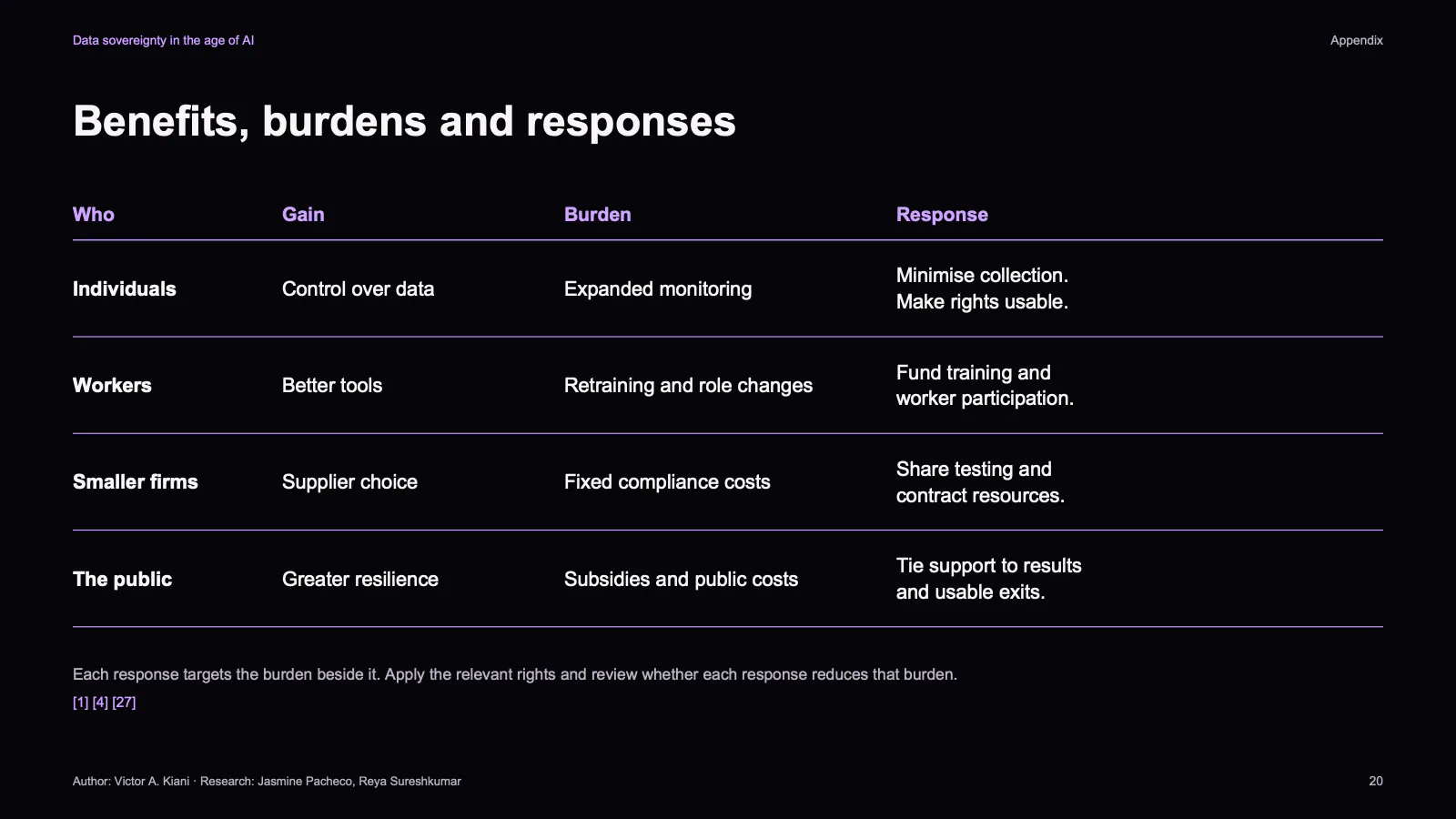
- Company control is not the same as personal rights. A firm can gain independence from its cloud supplier while expanding its own monitoring of customers or employees.
One assistant, many organizations
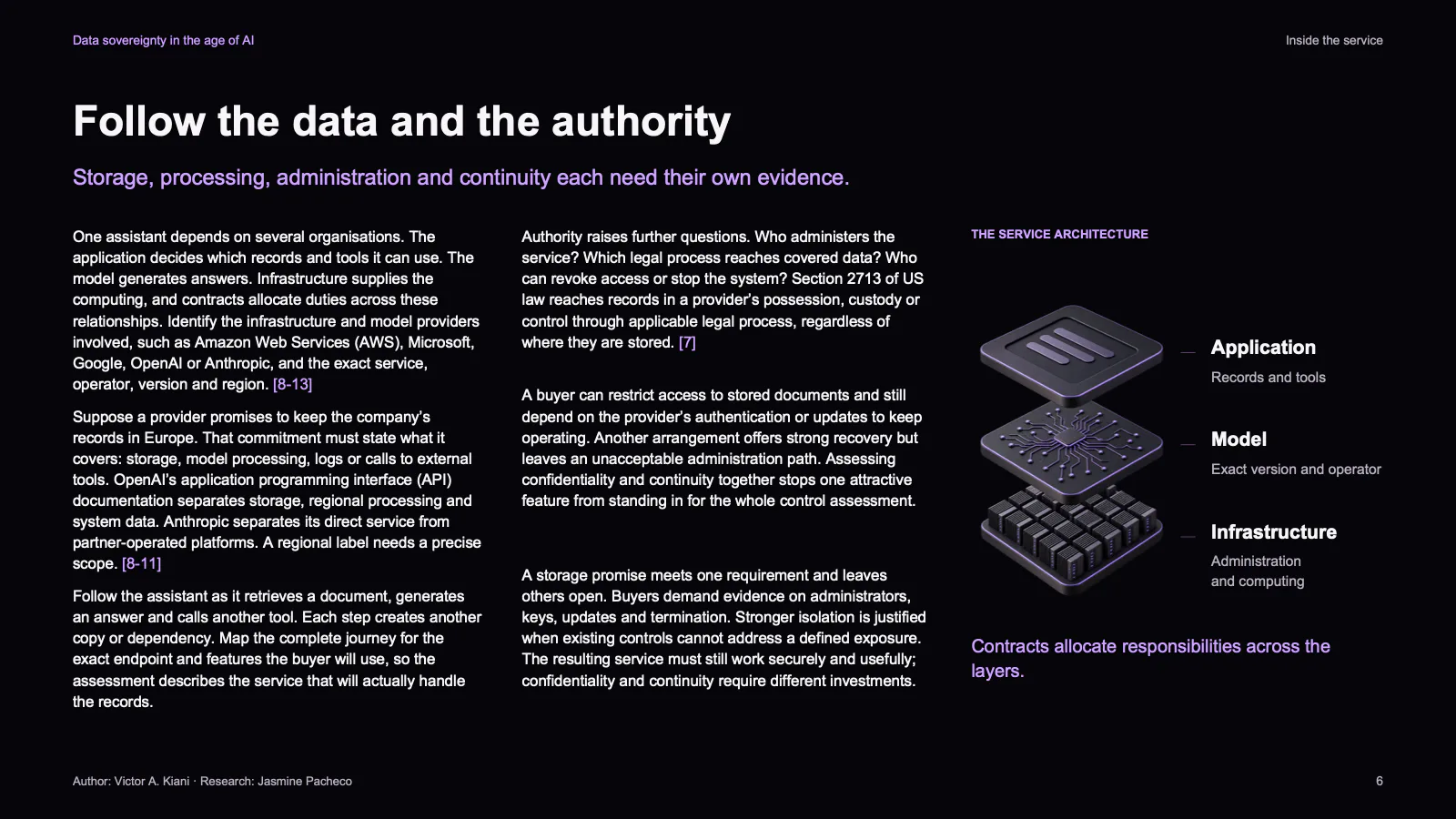
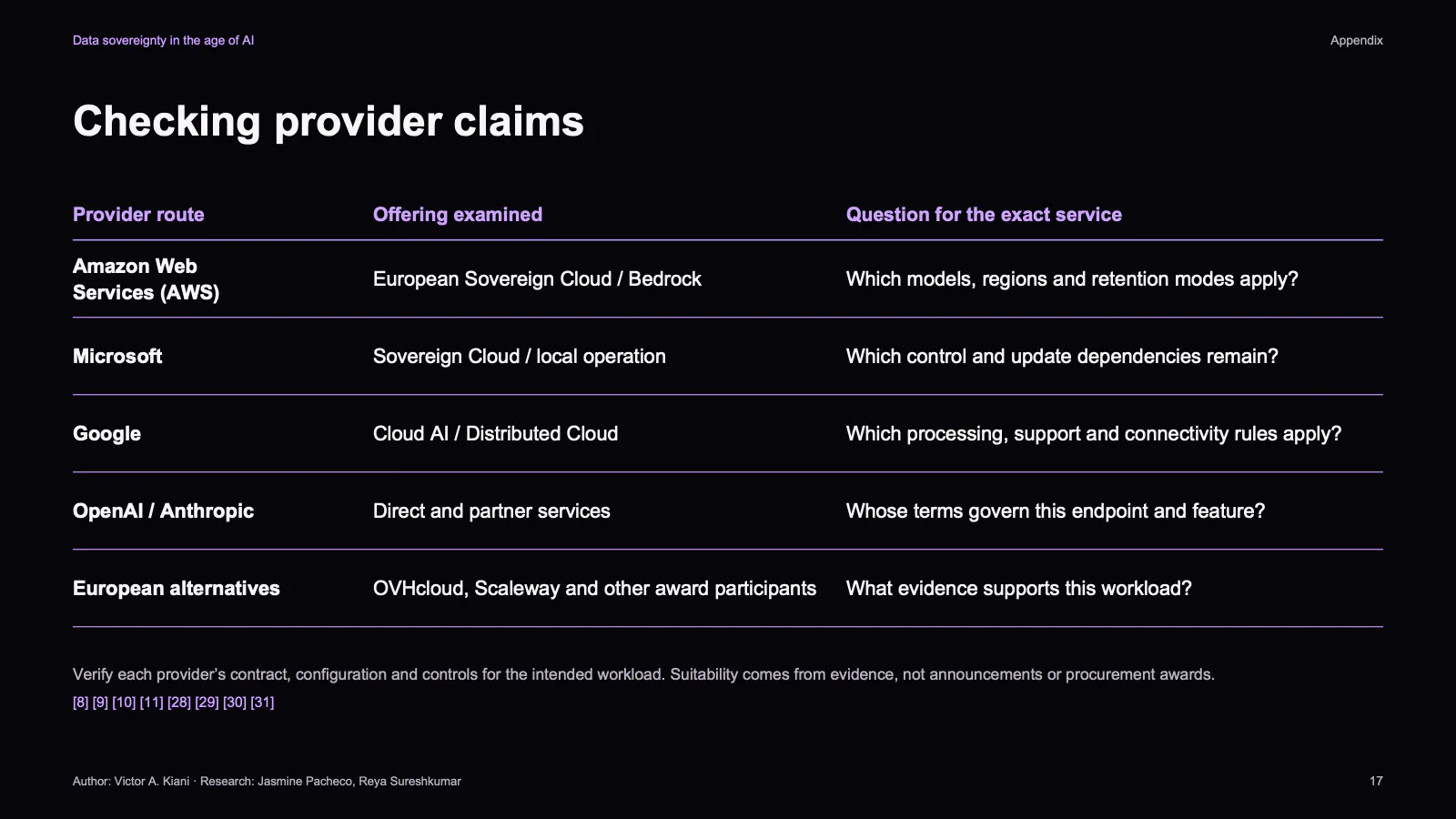
Kiani broke the service into layers: the application that decides which records and tools the assistant can use, the model that generates answers, the infrastructure that supplies computing and administration, and the contracts that allocate duties across all three. A promise to keep records in Europe has to say what it covers, whether storage, model processing, logs, or calls to outside tools. Provider documentation from OpenAI and Anthropic already draws those lines, so the buyer's job is to map the exact endpoint, operator, version, and region it will use.
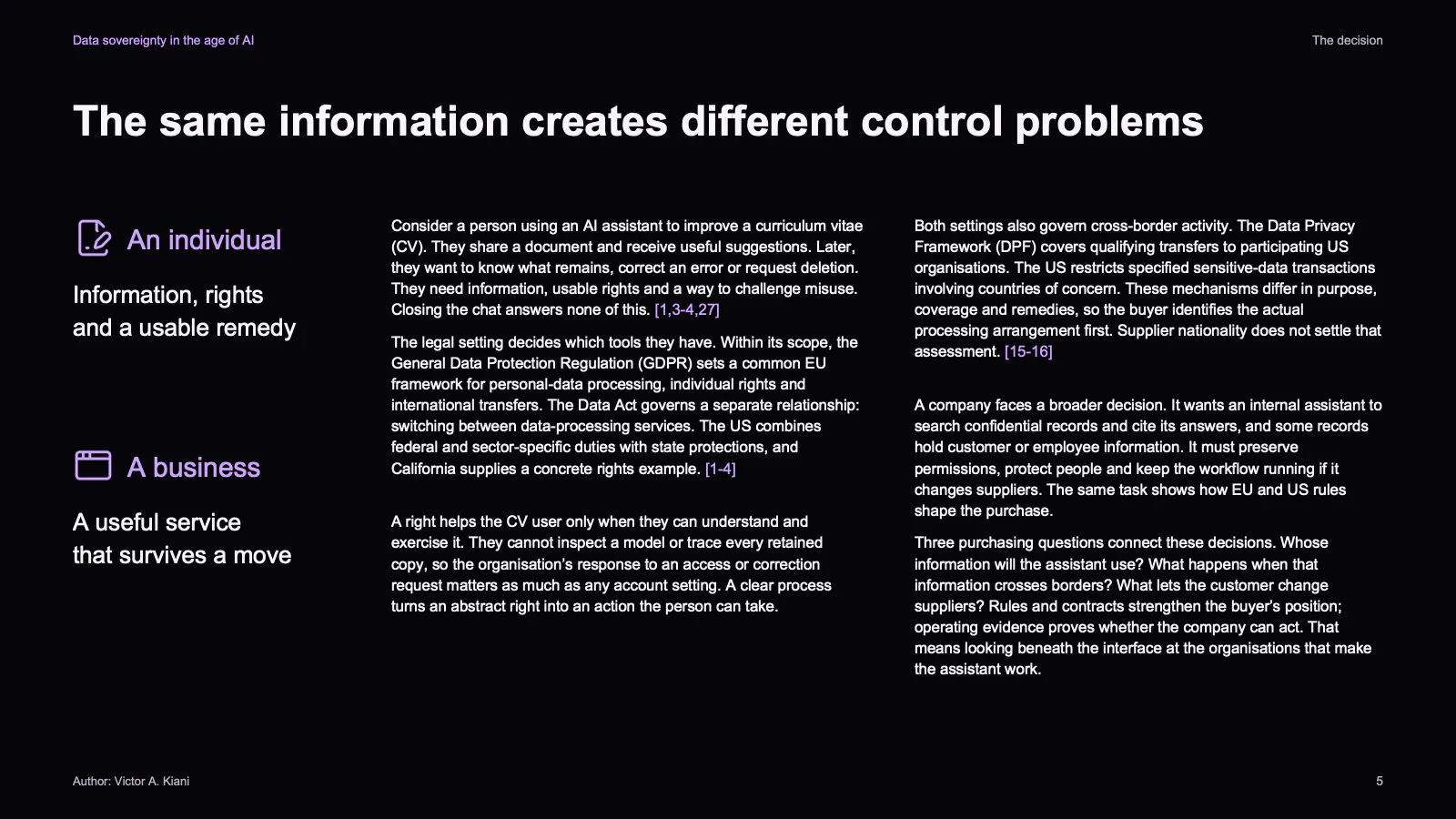
The same questions apply to a person. Someone who shares a CV with an AI assistant may later want to know what was kept, correct an error, or ask for deletion. Closing the chat answers none of that. A right helps only when the organization's response to the request actually works.
Three markets, one business
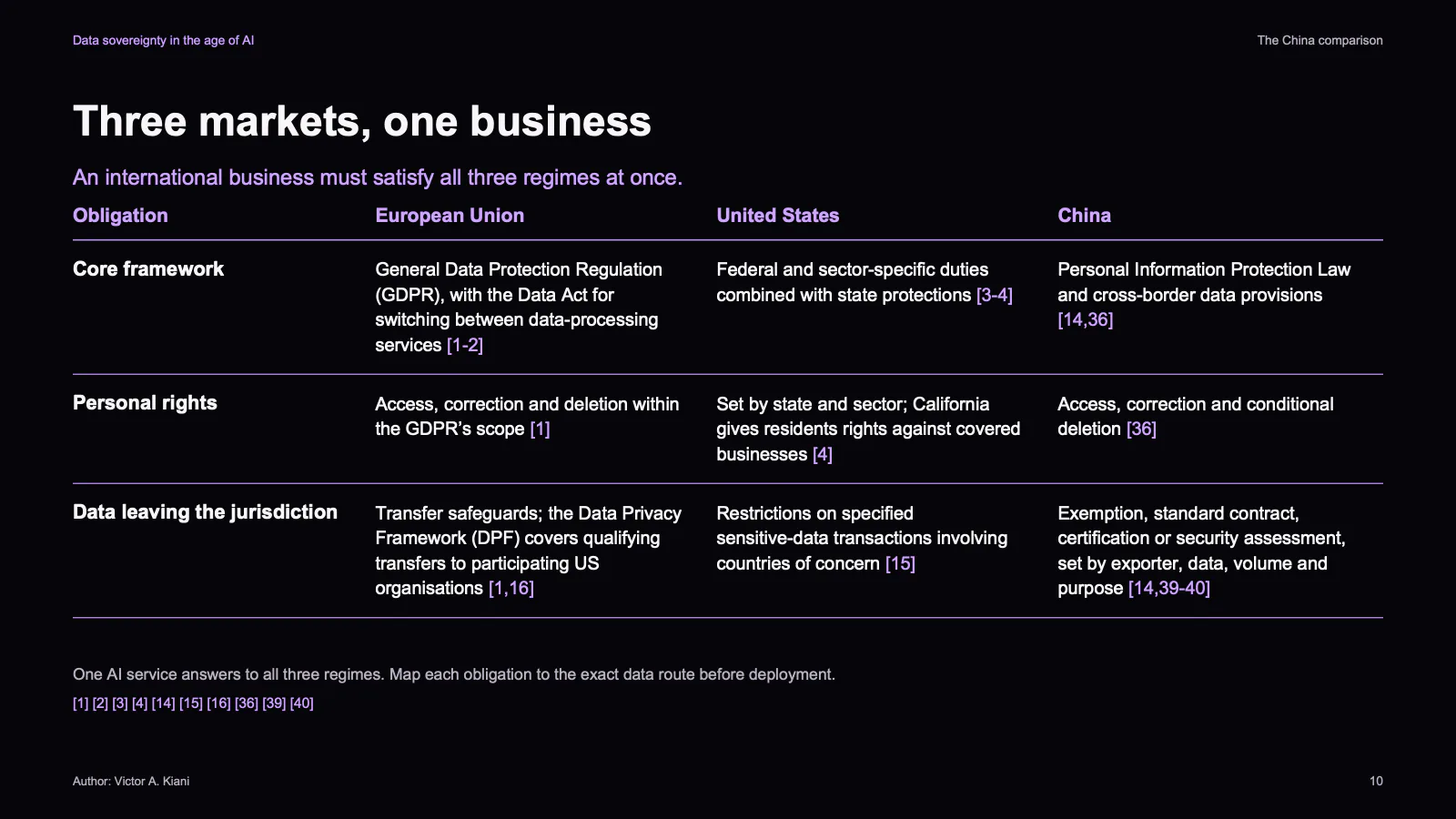
The European Union and the United States form the core comparison. China is the third rulebook an international business has to satisfy at the same time.
European Union
- Framework
- GDPR, with the Data Act for switching between data-processing services
- Rights
- Access, correction, and deletion within the GDPR's scope
- Transfers
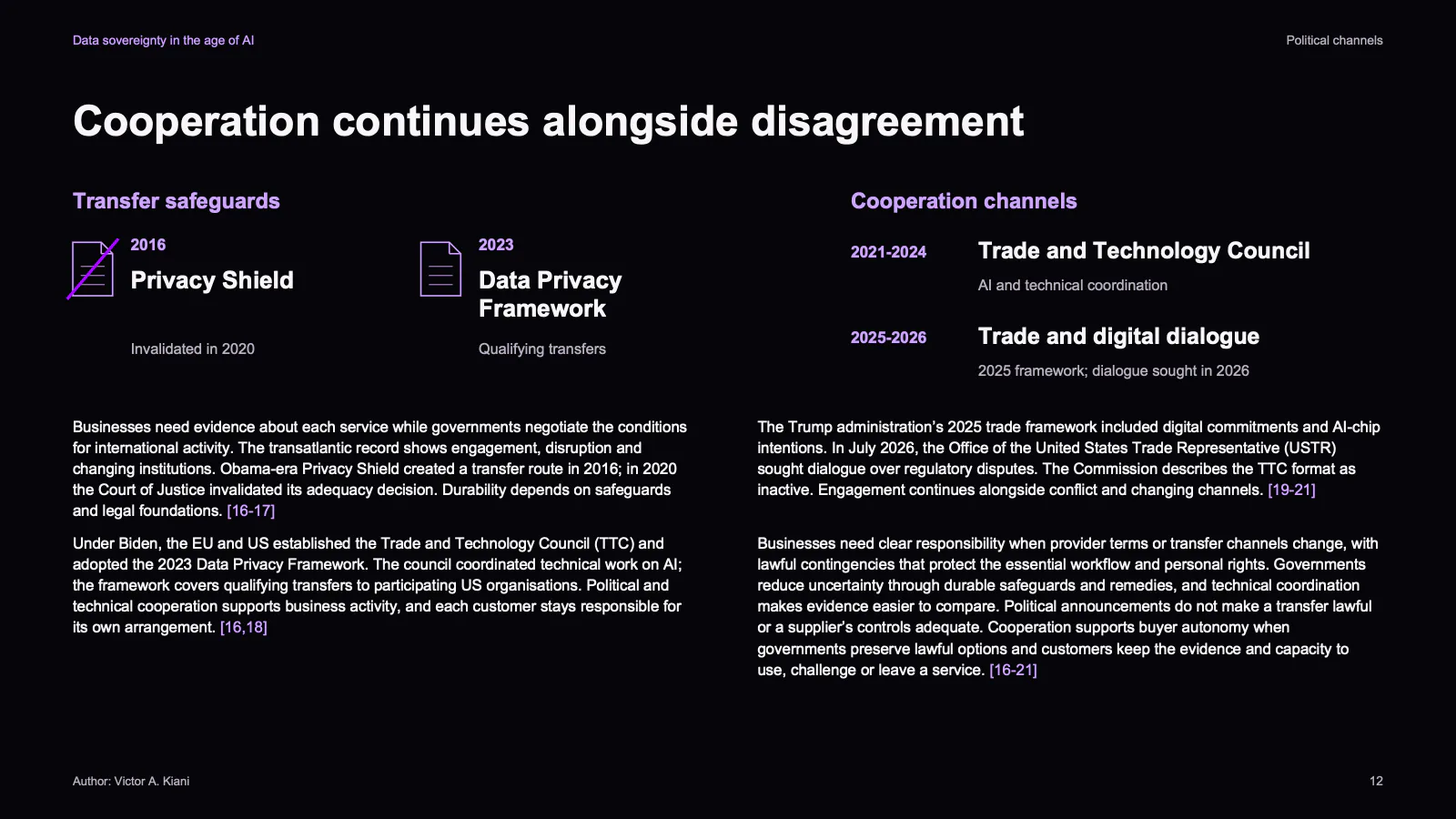
- Transfer safeguards; the Data Privacy Framework covers qualifying transfers to participating U.S. organizations
United States
- Framework
- Federal and sector-specific duties combined with state protections
- Rights
- Set by state and sector; California gives residents rights against covered businesses
- Transfers
- Restrictions on specified sensitive-data transactions involving countries of concern
China
- Framework
- Personal Information Protection Law and cross-border data provisions
- Rights
- Access, correction, and conditional deletion
- Transfers
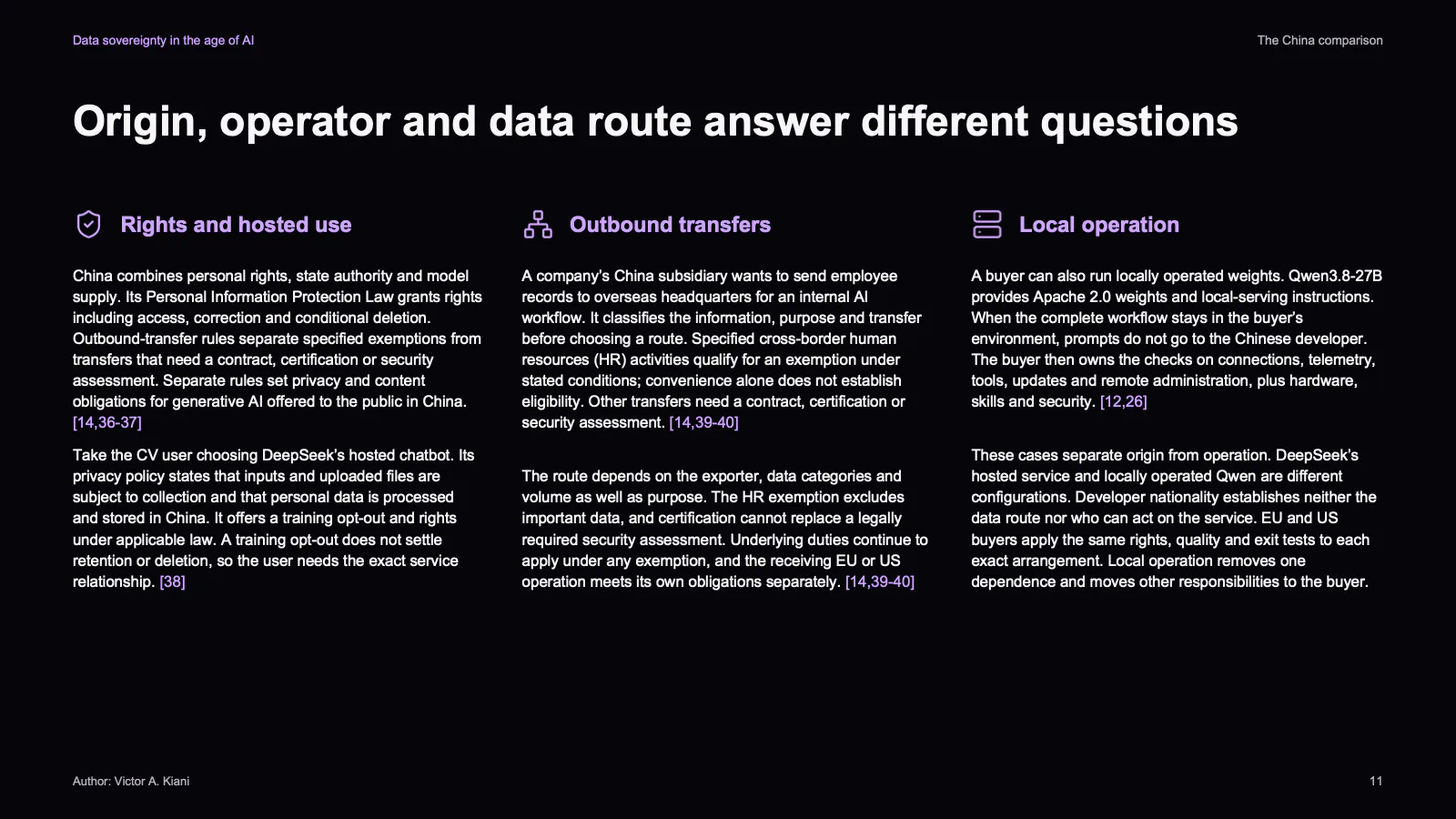
- Exemption, standard contract, certification, or security assessment, depending on the exporter, data, volume, and purpose
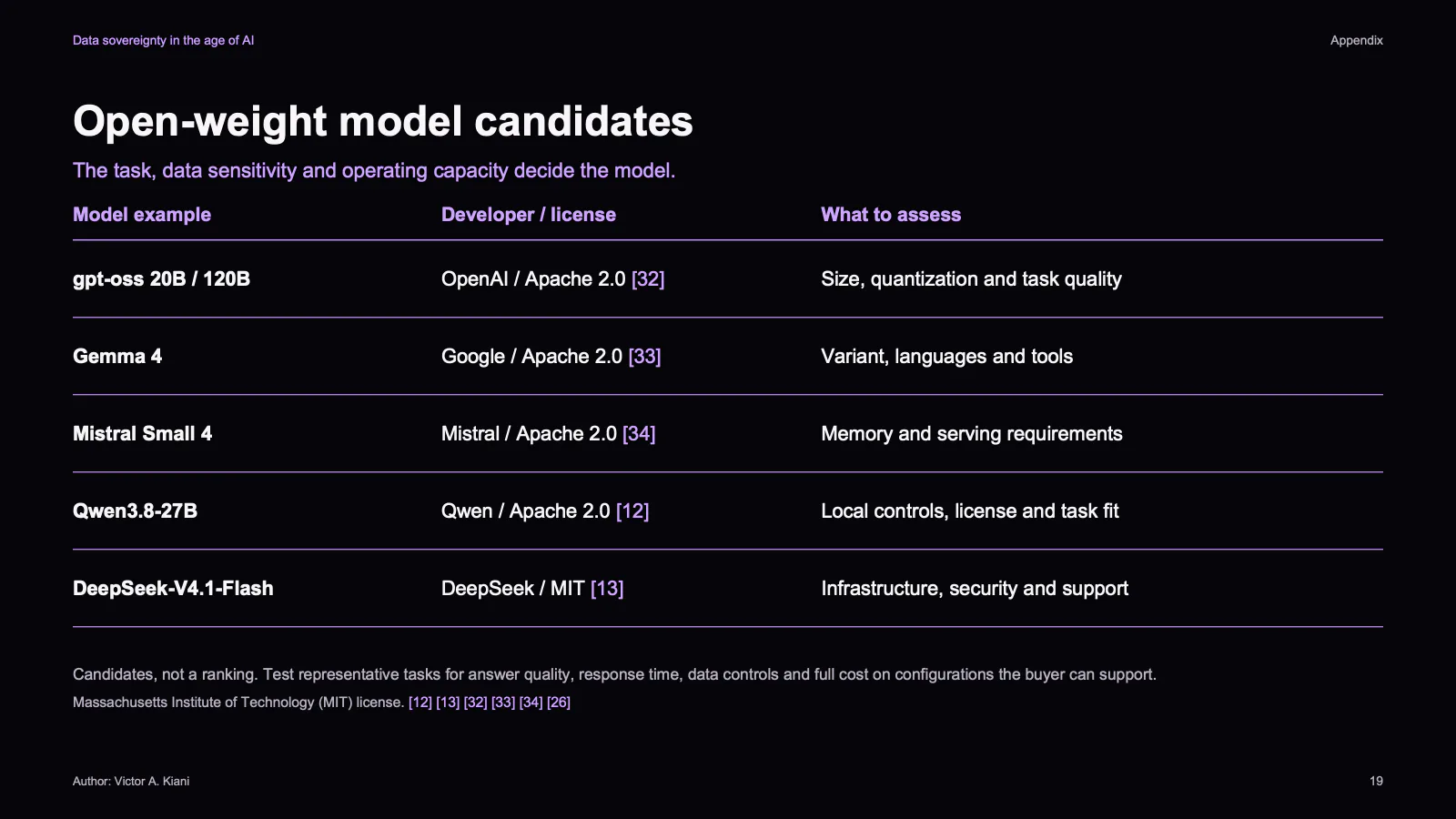
China also showed why a model's origin is a different question from its operation. DeepSeek's hosted chatbot states that personal data is processed and stored in China. A buyer running Qwen's openly licensed weights in its own environment keeps prompts away from the developer, but takes on the checks for connections, telemetry, updates, hardware, and security itself. Developer nationality establishes neither the data route nor who can act on the service.
The leverage is in the exit
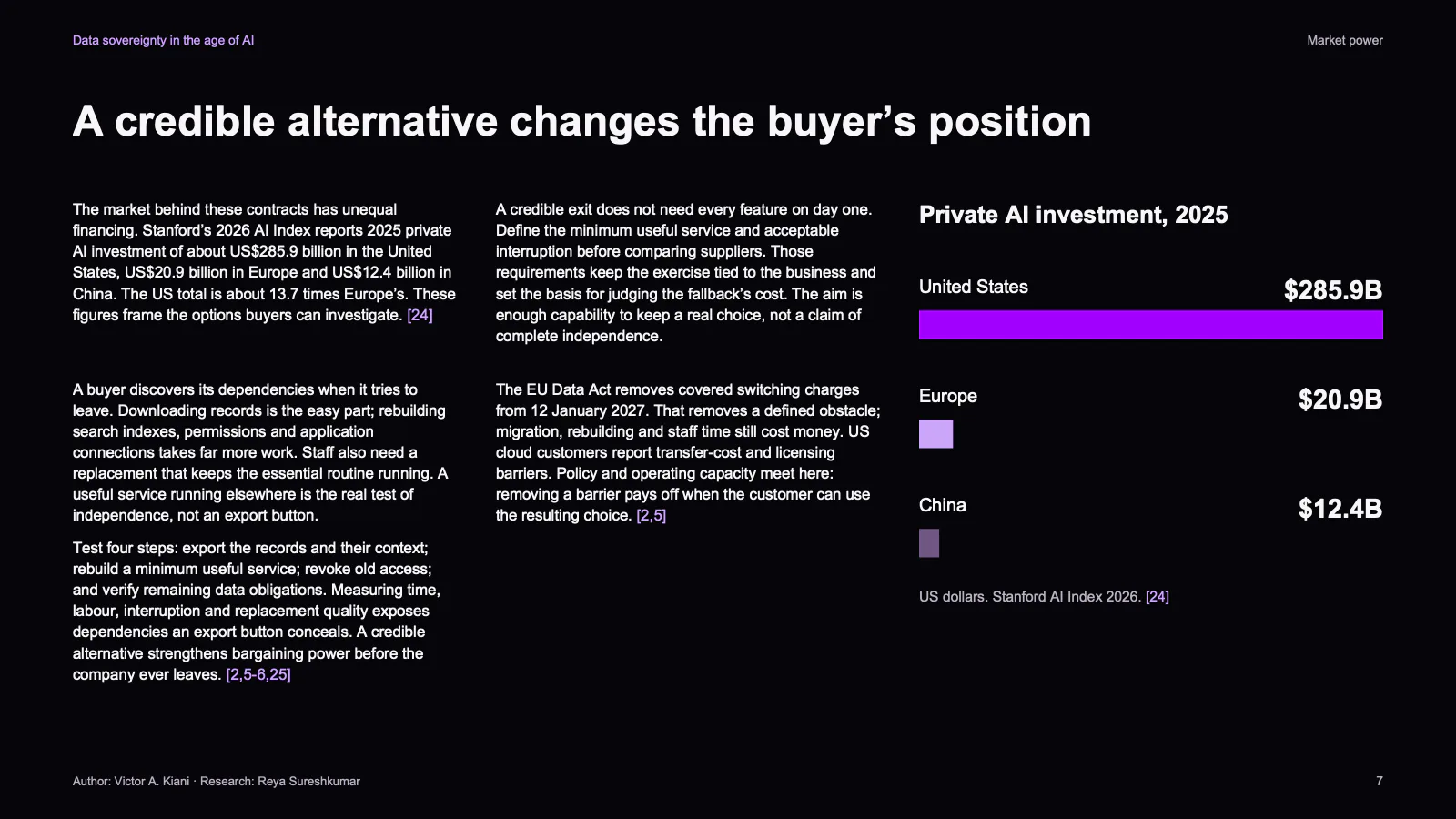
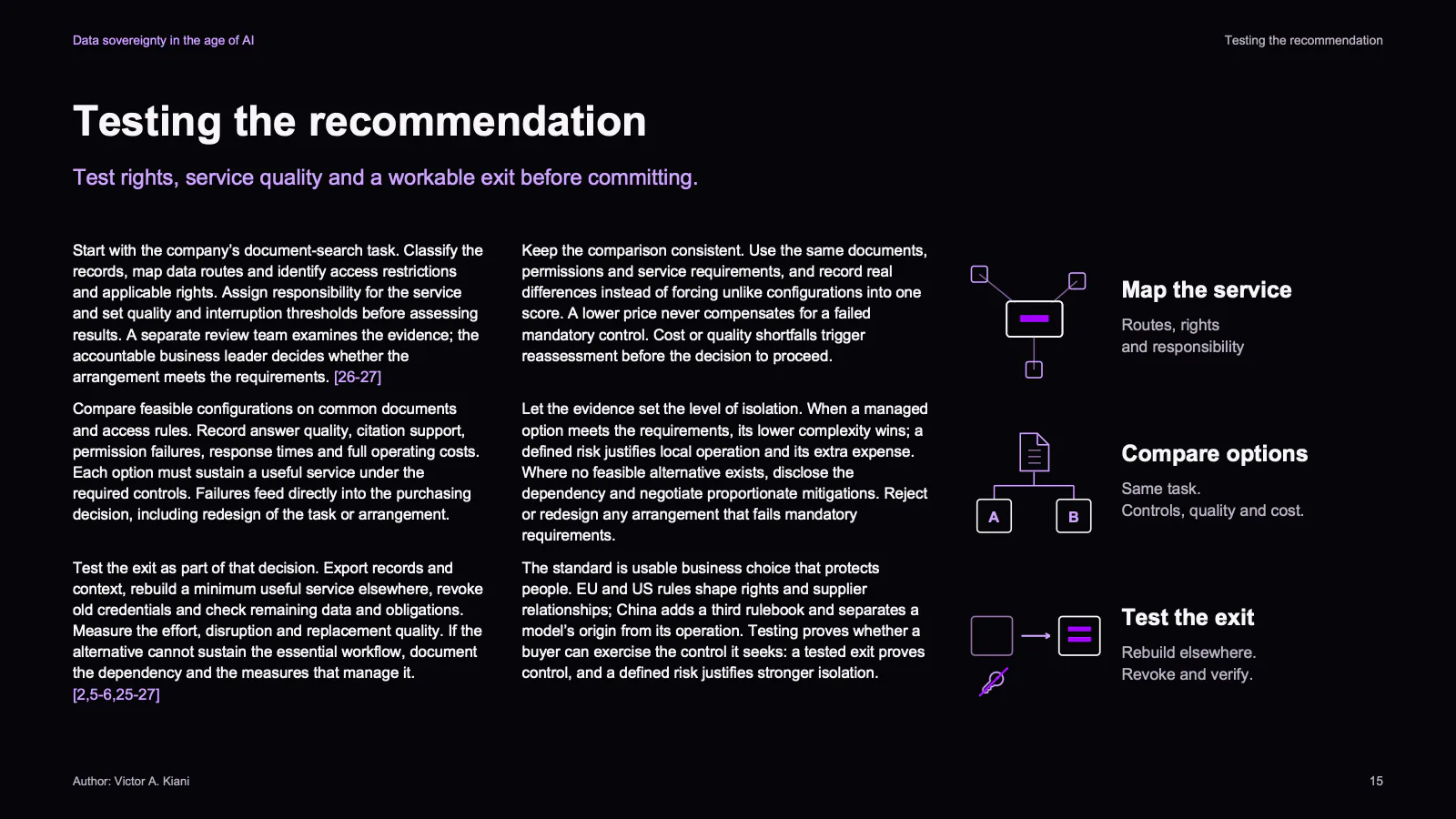
Stanford's 2026 AI Index puts 2025 private AI investment at about $285.9 billion in the United States, $20.9 billion in Europe, and $12.4 billion in China. In a market that concentrated, Kiani argued, a buyer discovers its dependencies when it tries to leave. Downloading records is the easy part. Rebuilding search indexes, permissions, and connections, while staff keep the essential work running, is where independence is proven. He proposed a four-step exit test:
- 01
Export
Export the records and their context.
- 02
Rebuild
Rebuild a minimum useful service with another supplier.
- 03
Revoke
Revoke the old supplier's access.
- 04
Verify
Check which data and obligations remain.
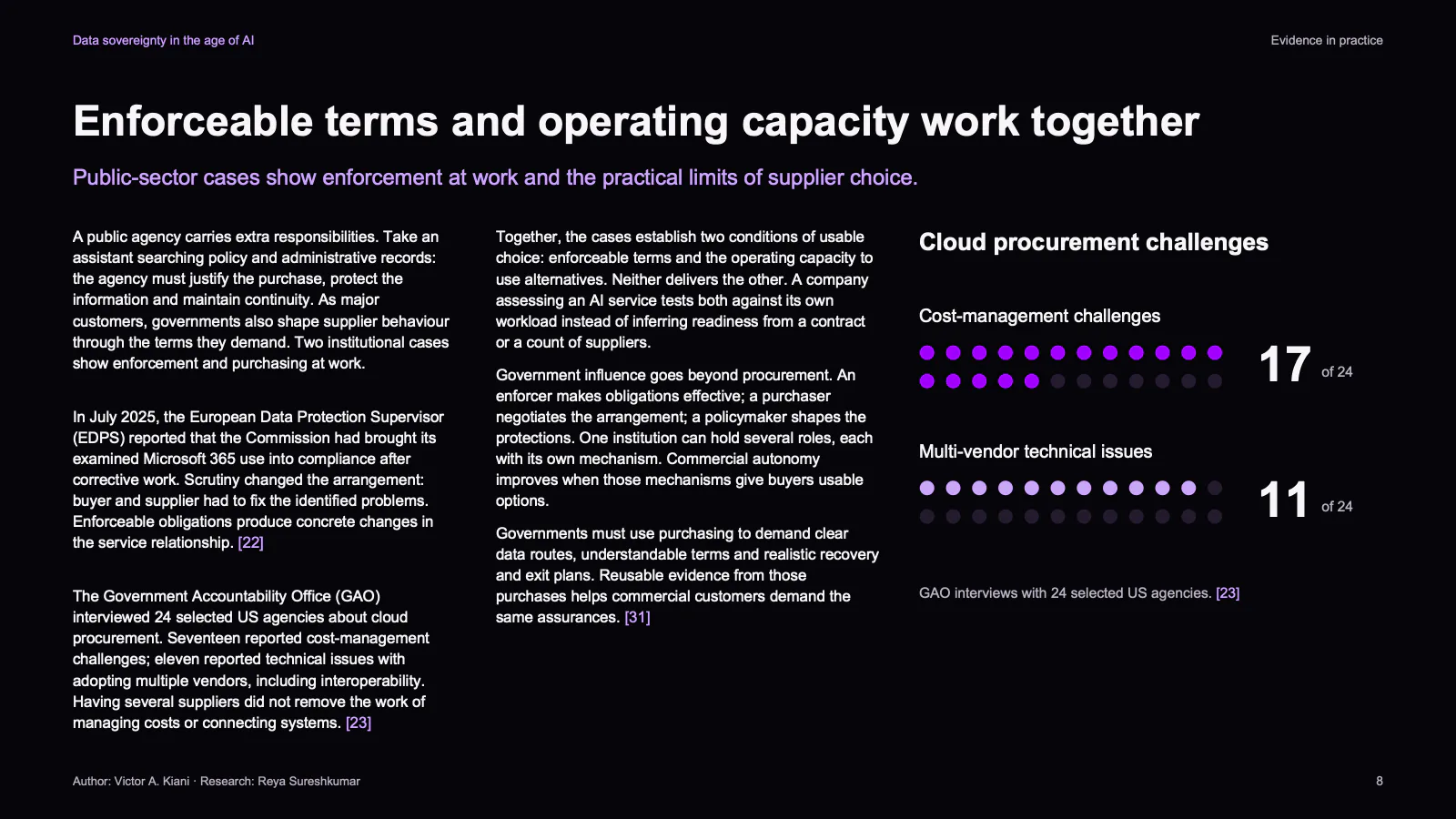
Measuring the time, labor, interruption, and replacement quality of that exercise exposes what an export button conceals. Two public-sector cases grounded the point. In July 2025, the European Data Protection Supervisor reported that the European Commission had brought its Microsoft 365 use into compliance after corrective work. When the U.S. Government Accountability Office interviewed 24 agencies about cloud procurement, 17 reported cost-management challenges and 11 reported technical problems with using multiple vendors. Usable choice needs both enforceable terms and the operating capacity to use an alternative.
Three gates before any purchase
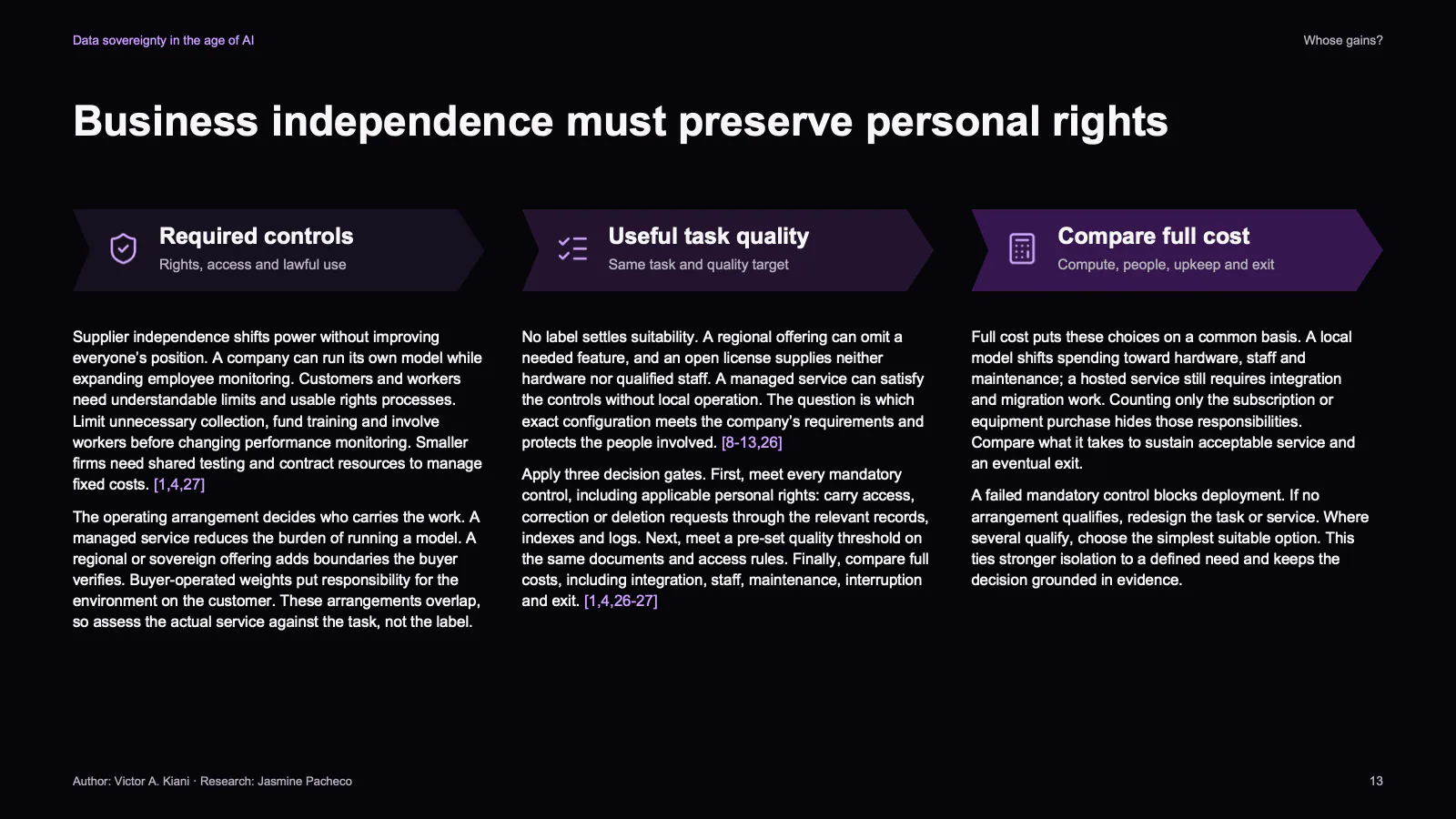
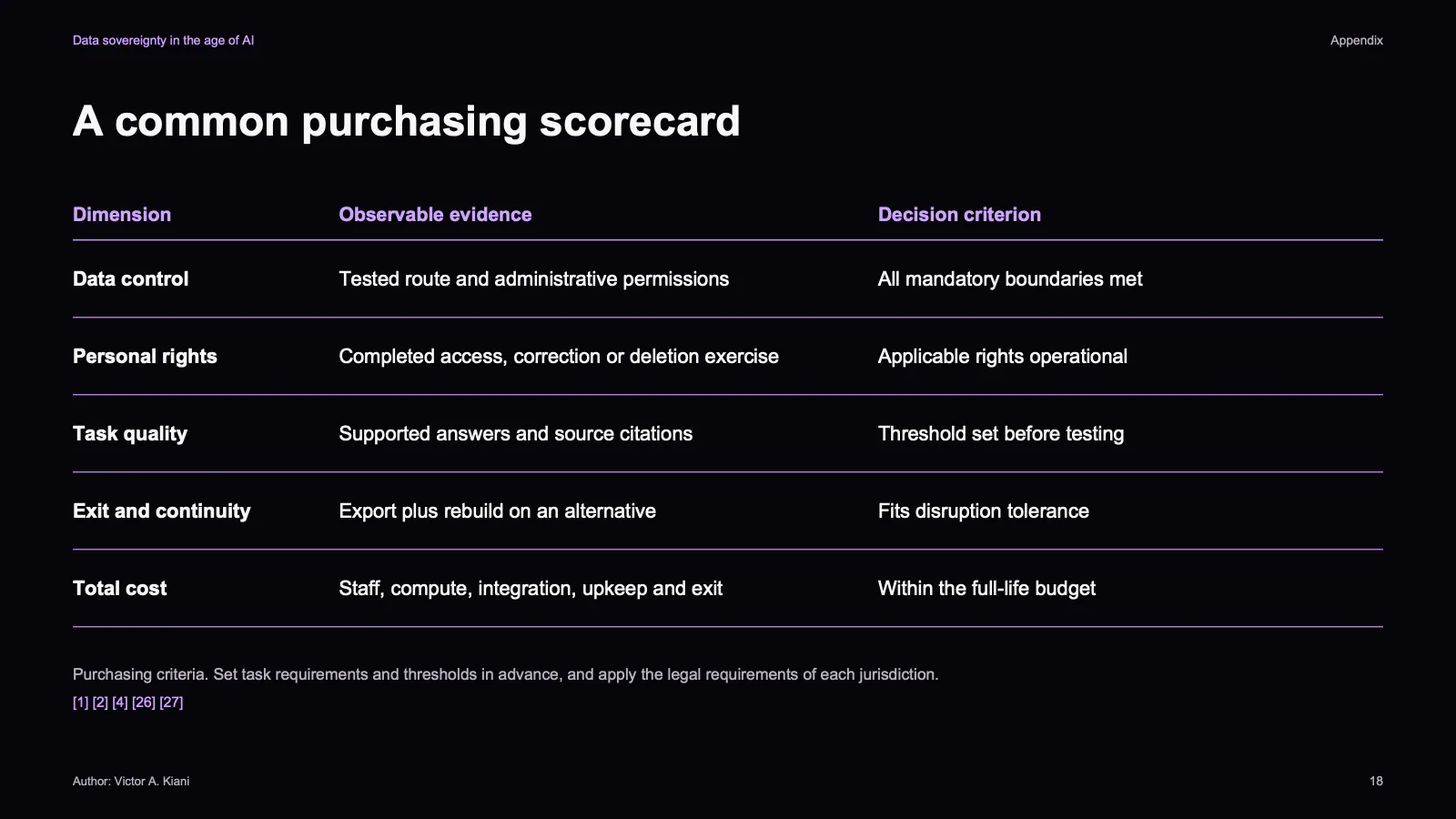
The report turned the analysis into a decision a business can run on its own workload:
- 01
Meet every mandatory control
Including personal rights: carry access, correction, and deletion requests through the records, indexes, and logs.
- 02
Meet a quality threshold set in advance
Test every option on the same documents and access rules.
- 03
Compare the full cost
Integration, staff, maintenance, interruption, and exit, not just the subscription or the hardware.
A failed mandatory control blocks deployment, and a lower price never makes up for it. Where several options qualify, the simplest suitable one wins. Stronger isolation, such as running a model locally, is reserved for a defined risk that existing controls cannot address.
Lessons in both directions
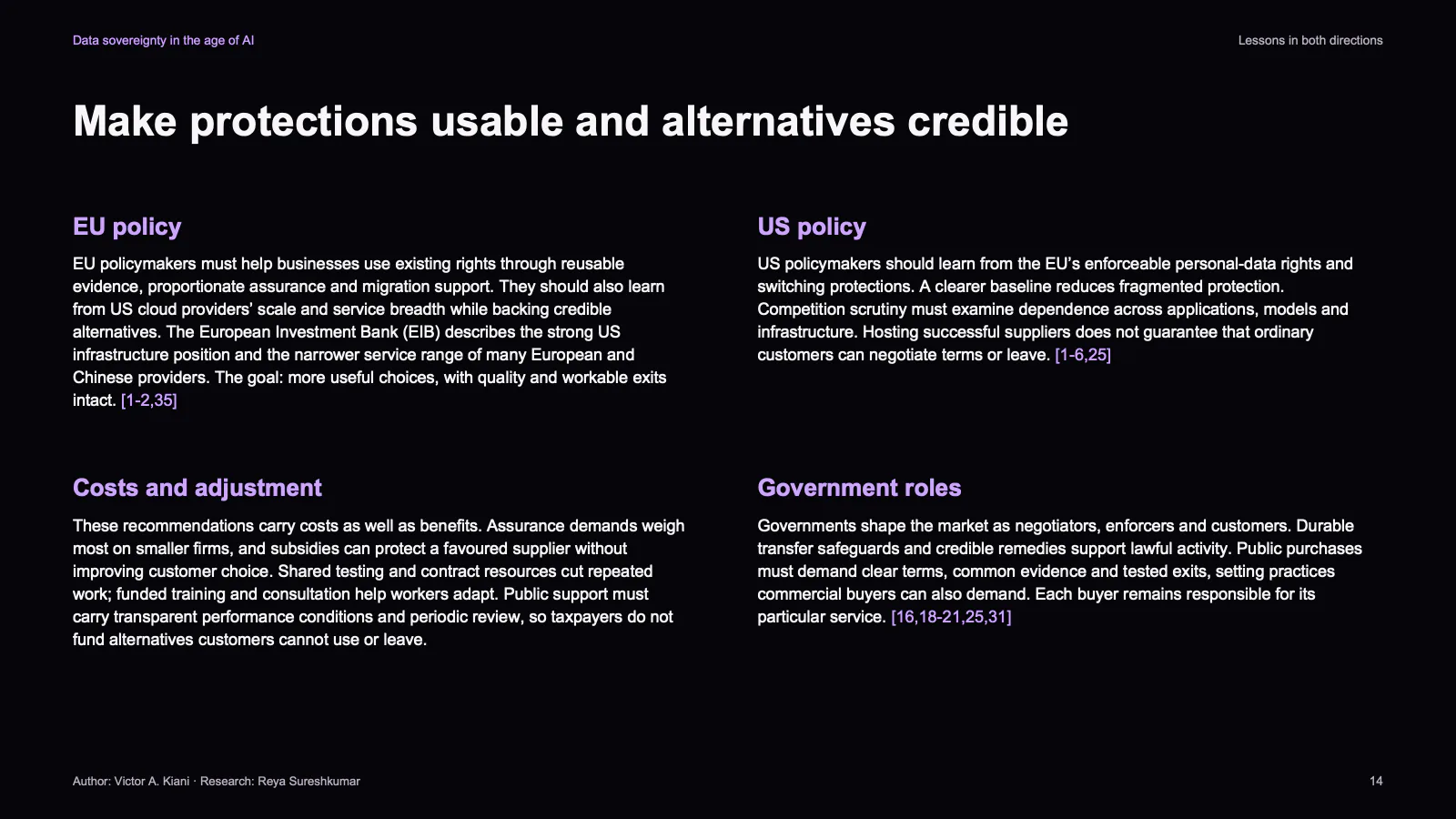
The policy recommendations ran both ways across the Atlantic. The EU should make its existing rights and switching rules usable for smaller firms, and learn from the scale of U.S. cloud ecosystems while funding credible alternatives, without treating local ownership as proof of control. The U.S. should learn from the EU's enforceable personal-data rights and portability, because hosting successful suppliers does not guarantee that ordinary customers can negotiate terms or leave.
Governments also shape the market as customers. Public purchases can demand clear data routes, understandable terms, and tested exits, setting a standard commercial buyers can then ask for. The transatlantic record, from Privacy Shield's invalidation in 2020 to the 2023 Data Privacy Framework and the trade dialogue of 2025 and 2026, shows cooperation continuing alongside disagreement. A political announcement never makes a transfer lawful on its own.
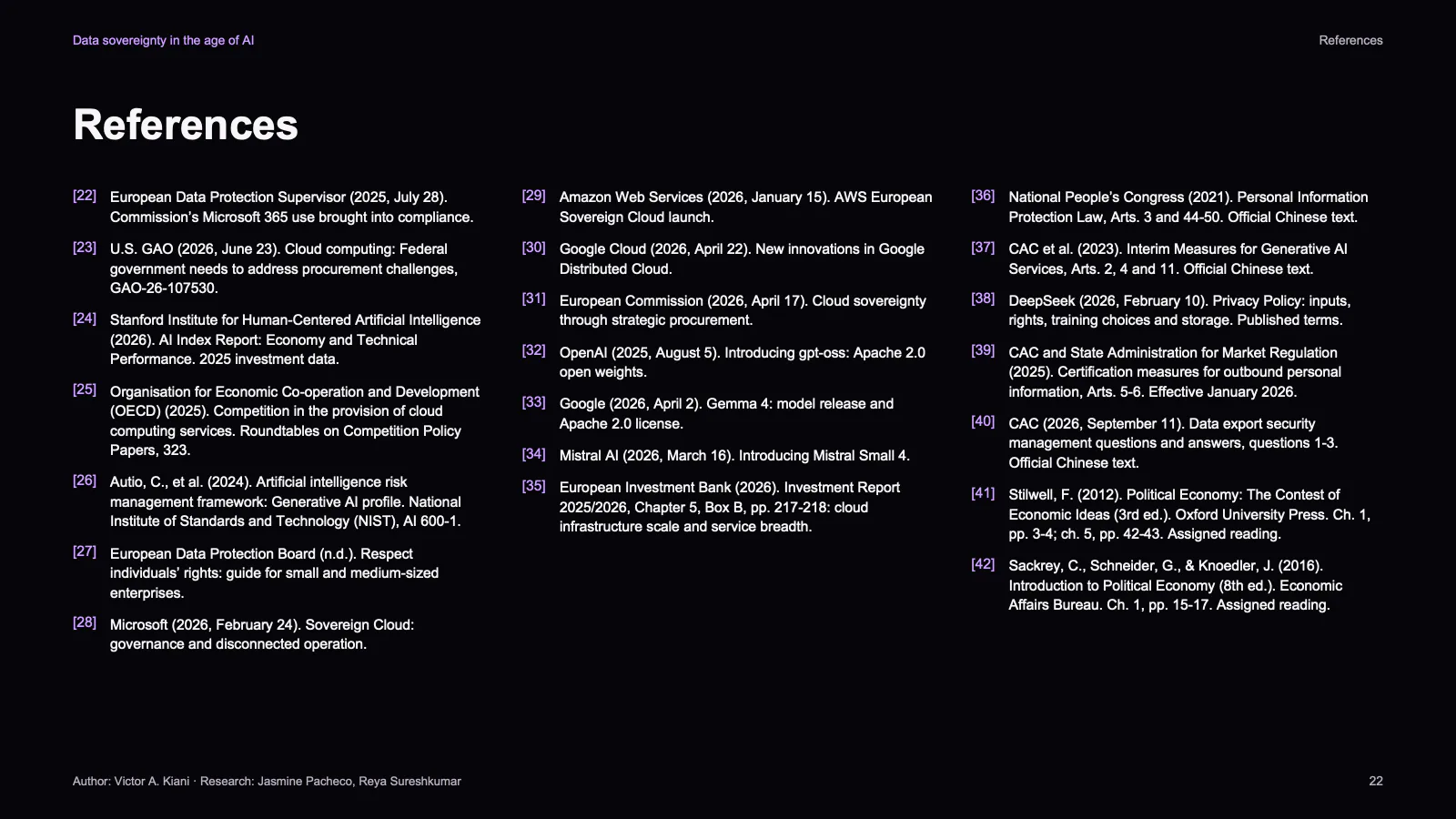
The analysis drew on the course's framework, Frank Stilwell's institutional view of markets and Sackrey, Schneider, and Knoedler's account of economic power, and organized every recommendation around three questions: who holds rights, who holds leverage, and who carries the costs. Its conclusion fits in one line: a tested exit proves control, and a defined risk justifies stronger isolation.
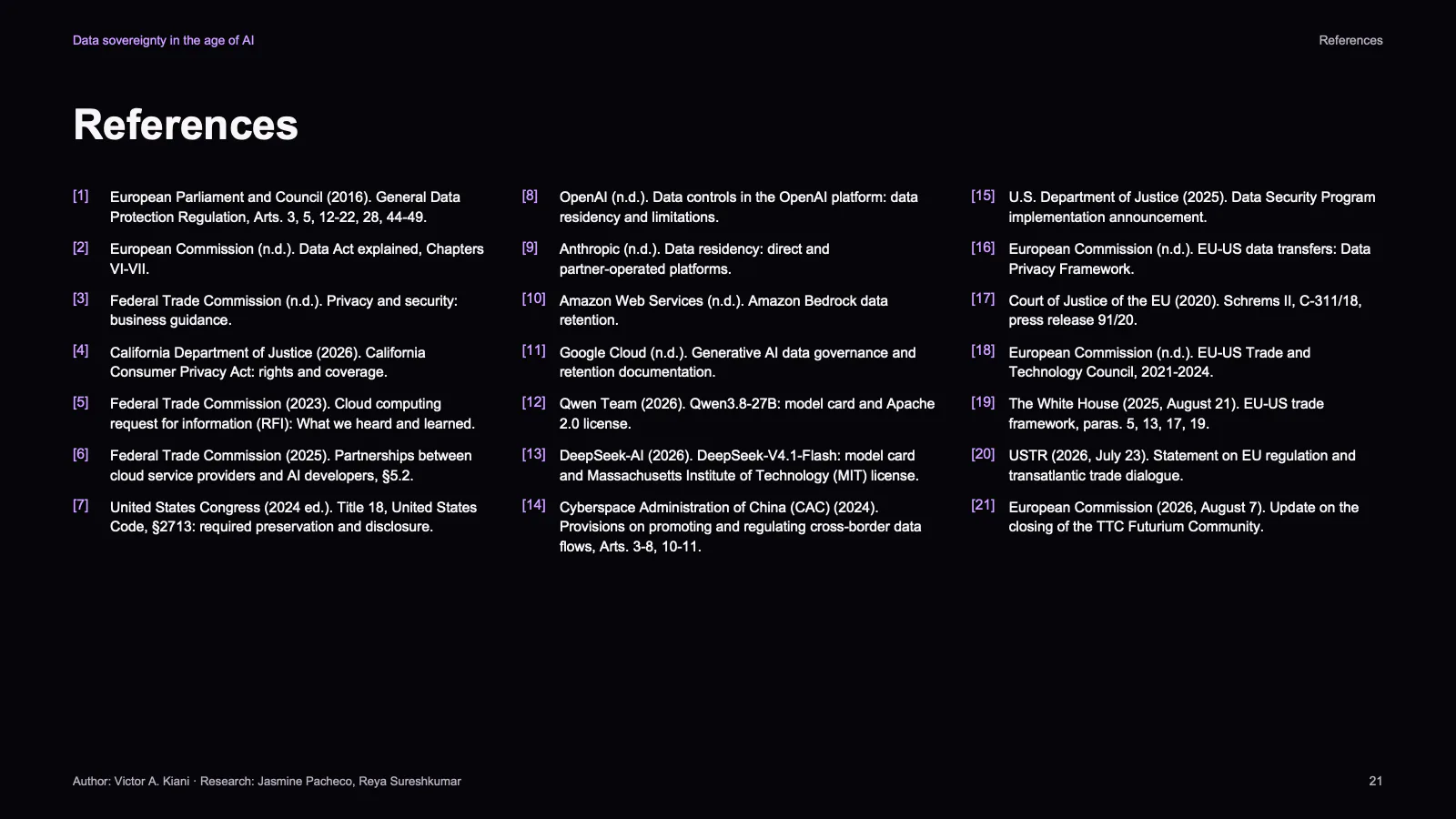
Sources
- European Union · General Data Protection Regulation (2016)
- European Union · Data Act, Regulation 2023/2854
- California Department of Justice · California Consumer Privacy Act
- U.S. Code · 18 U.S.C. § 2713, required preservation and disclosure
- Court of Justice of the EU · Schrems II press release (2020)
- EU-U.S. Data Privacy Framework
- Stanford HAI · AI Index Report (2026)